AI virtual patient practice
Walk into your OSCE having already done it.
Scaling clinical reasoning in medical education — developing clinicians who make better decisions and helping keep patients safer.
How MEKSI is taught
Global. Flipped. Classroom.
One standard for clinical reasoning, prepared online before class and sharpened together in the room.

Global
One standard. One community.
Professors and clinicians from around the world teach, learn and collaborate in one community — so the same standard of clinical reasoning is taught wherever a student trains.
Flipped
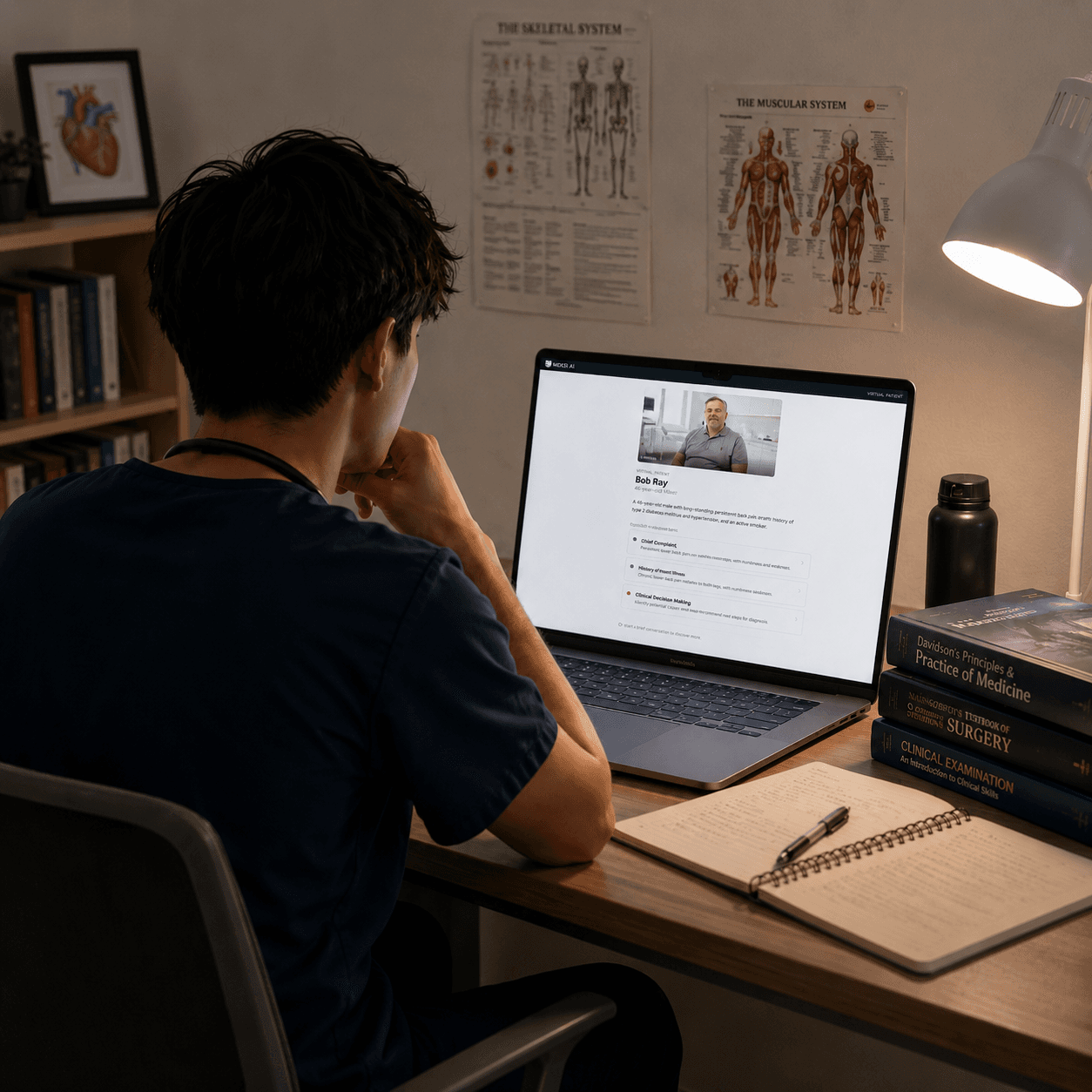
Students prepare online, before class.
Students work through interactive cases with an AI tutor, developing their reasoning before they walk into the room.

Classroom
One classroom. Stronger reasoning together.
Live, expert-led discussion turns that preparation into better decisions — and, over a course, into stronger clinicians.
Flipped → before class
Students prepare online
Students build understanding and develop clinical reasoning at their own pace.
1.Receive case or assignment
Students receive a clinical case or learning assignment from their instructor.
2.Learn with the AI tutor and resources
Students learn using AI tutor guidance, videos, readings and curated resources tailored to the case.
3.Practise reasoning and get feedback
Students analyse the case, generate differentials, interpret findings and receive AI feedback that strengthens their reasoning.
4.Build confidence before class
Students consolidate their understanding and submit their reasoning, so they arrive ready to discuss it.
Classroom → in class
Discuss and apply
Students collaborate with peers and experts to deepen the reasoning they arrived with.
1.Share reasoning with peers
Students share their initial reasoning and their approach with classmates.
2.Discuss and challenge ideas
Students challenge assumptions, compare perspectives and explore alternative explanations.
3.Refine reasoning together
Guided discussion and expert facilitation sharpen the group's clinical reasoning and decision-making.
4.Reach the best decision
The class reaches a consensus and plans the best next steps for the patient.
Built for two audiences
One platform, two very different jobs to do.
Individuals need reps before the real exam. Institutions need consistency, coverage, and a report at the end. MEKSI does both from the same case engine.
 For individuals
Walk in having already done it
Start with a free case — no card, no account. Get a scored breakdown the moment you finish, then pick up free packs or buy a pack outright when you want more reps.
See the three ways in For institutions
Run a school or a whole cohort
License MEKSI across a program: consistent cases for every learner, and a cohort-level report at the end of each module so you can see who needs support.
Book a walkthroughWhy MEKSI
Structured practice, built to scale
MEKSI turns clinical reasoning practice into something scalable, consistent, and measurable — so every learner gets the same high-quality consultation experience, whatever the cohort size.

Current method
- Small group or one-on-one
- Difficult to standardise
- Hard to measure objectively
- Experience-dependent (varies by teacher)
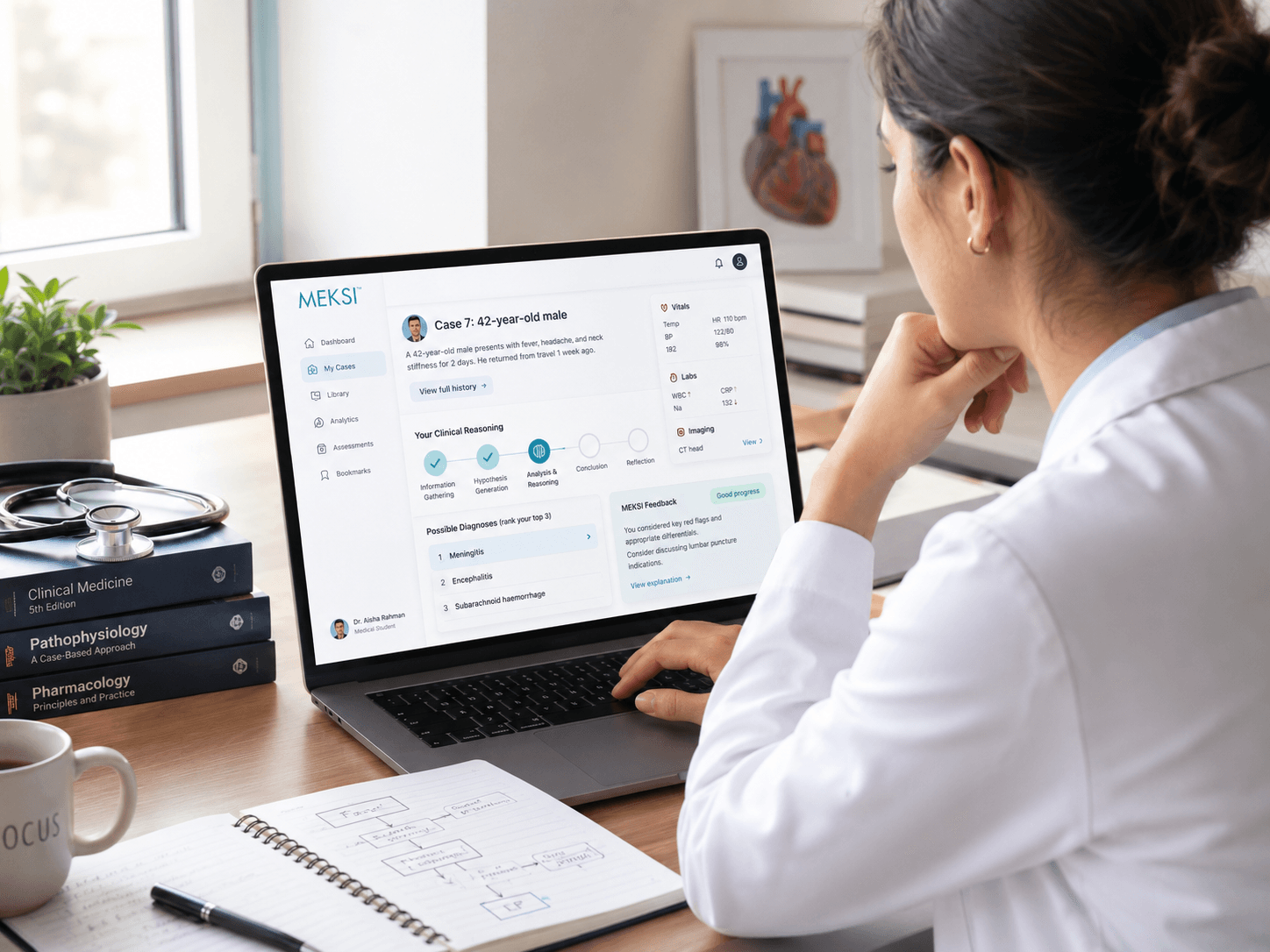
With MEKSI
- Scalable to any cohort size
- Consistent learning experience
- Structured clinical reasoning
- Observable and assessable cognition
How MEKSI is used
Three modes, one virtual patient
The same consultation engine supports the whole teaching cycle — individual practice, cohort-wide teaching, and formal assessment.
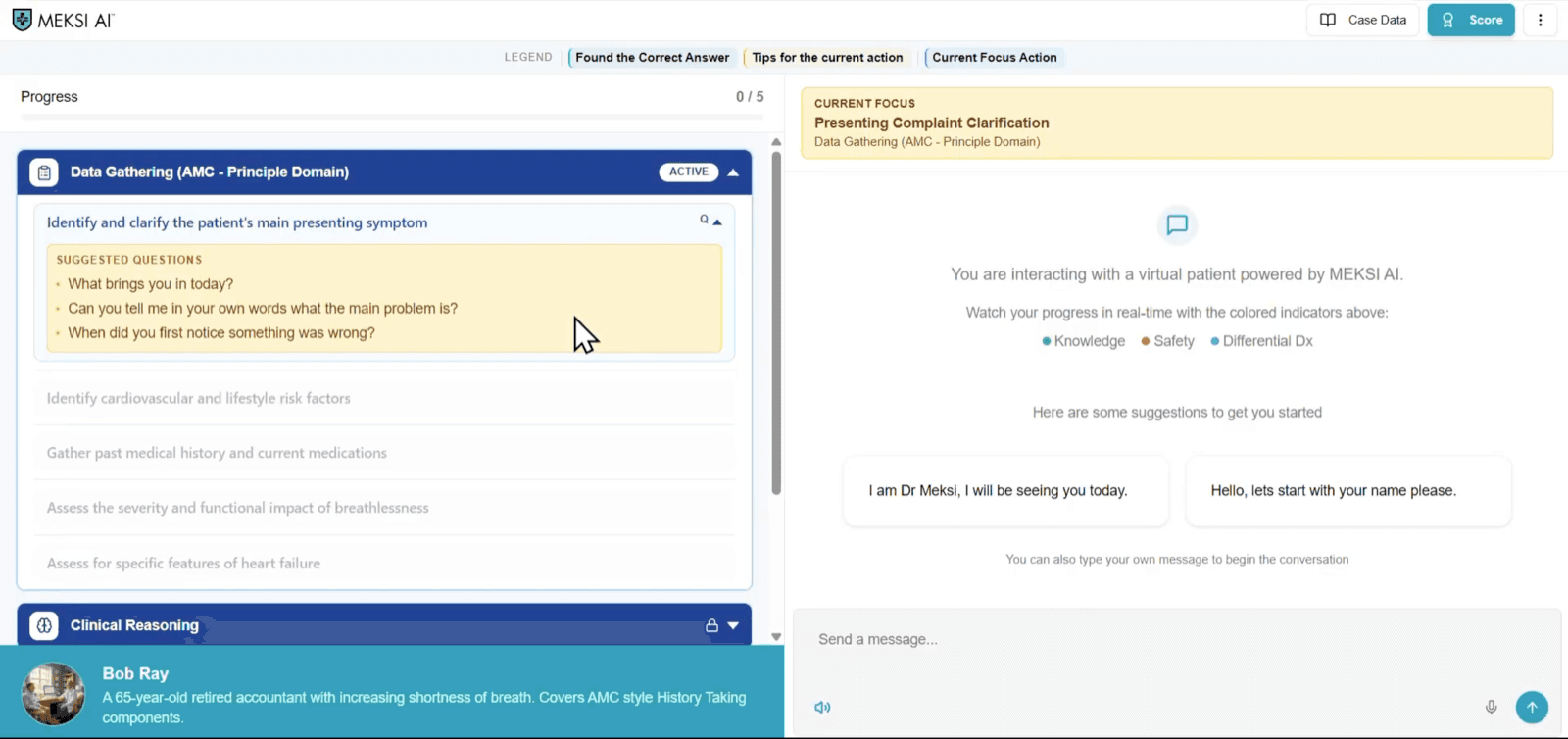
Learn mode
Practise at your own pace. Work a case as many times as you like, asking questions in your own words, and get a report after every attempt so you can see what you missed.
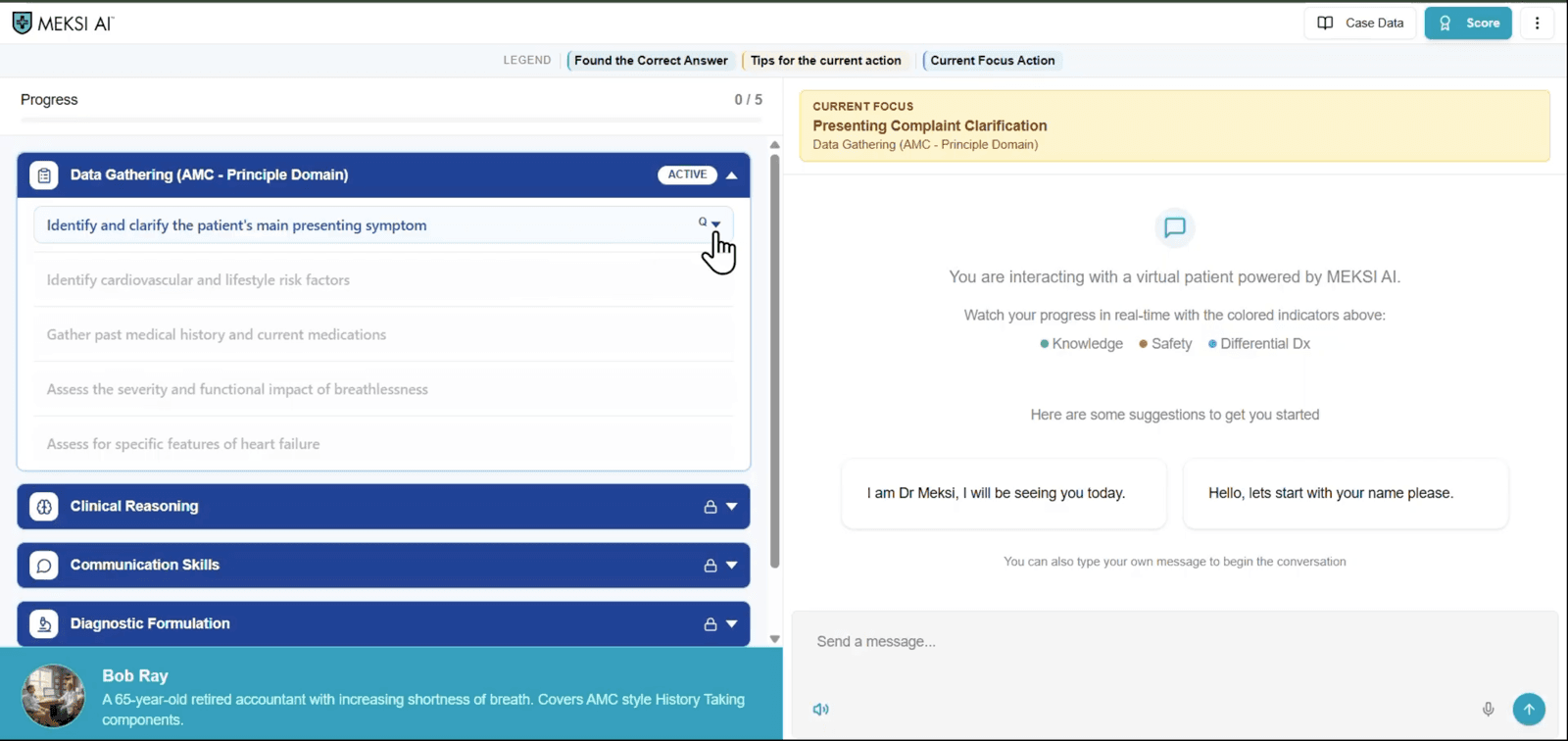
Teach mode
Set the same case for a whole cohort. Every student meets an identical standardised patient, so the teaching experience no longer varies with who is in the room.
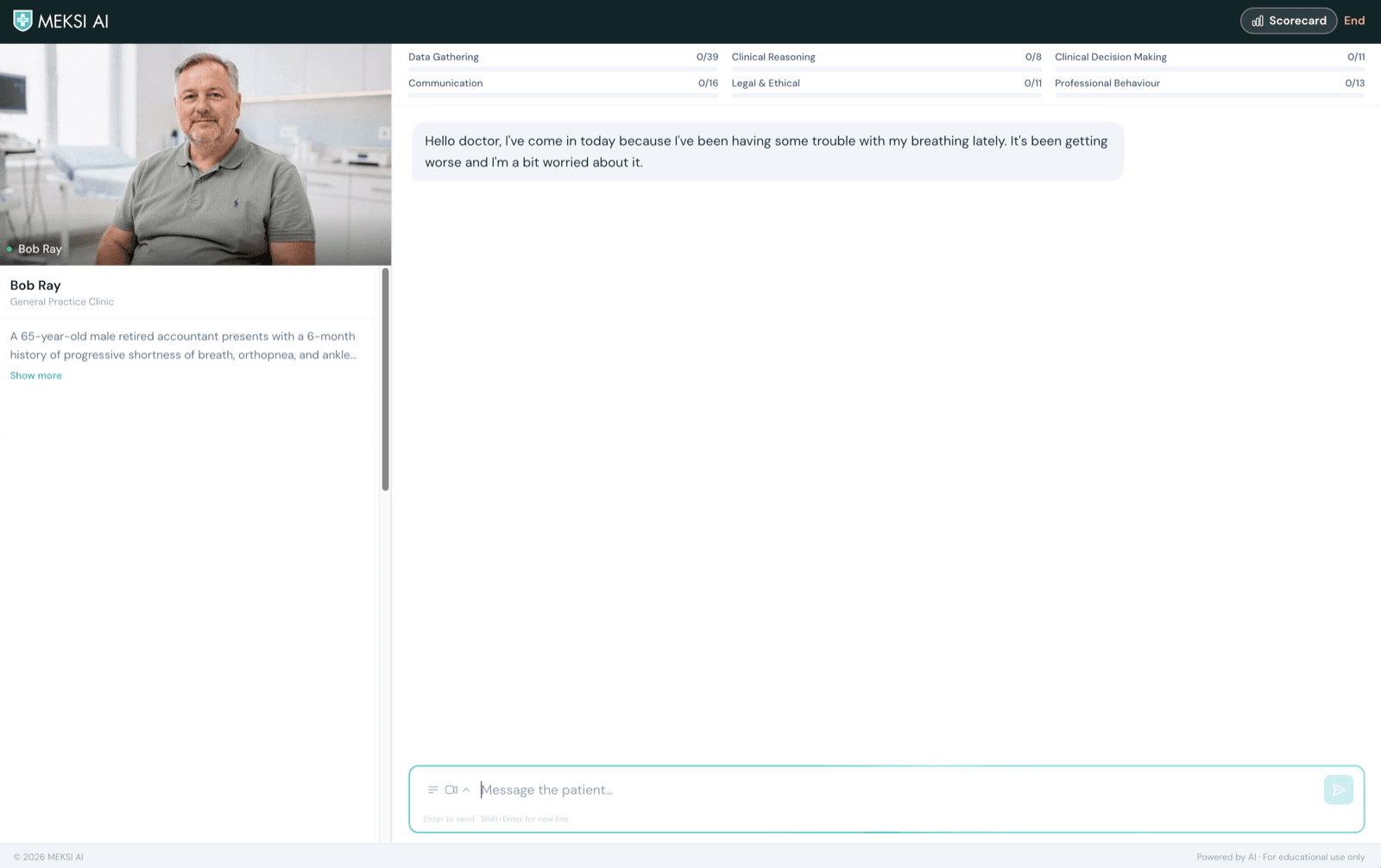
Assess mode
Score performance against a rubric. Data gathering, clinical reasoning, decision making and communication are marked consistently, making results comparable across a cohort.
How it works
Three steps. No setup.
Pick a case
Choose a specialty and difficulty, or let MEKSI hand you one at random — the way a real exam would.
Consult, your way
Run the consultation in text, voice, or video. Gather history, request exams and investigations, form a diagnosis.
Get a scored breakdown
See exactly where you gained and lost marks across data gathering, reasoning, decision making, and communication.
The MEKSI score
A score you can act on, not just a pass or fail.
Every consultation is scored live across four domains, the same way an examiner would mark you — so you know exactly which questions you missed and why they mattered.
No more guessing whether you “did okay.” You'll know whether you gathered the right data, reasoned toward the right differential, and communicated it clearly.
Case library
The specialties you'll be examined on.
Every case is written and reviewed by clinicians and mapped to the domains examiners actually mark against.
Cardiology
Respiratory
Psychiatry
Rheumatology
Neurology
Obstetrics & Gynaecology
Gastroenterology
Paediatrics
21 cases across 8 specialties. Browse the catalog to see what's available today.
What students say
How MEKSI is building clinical confidence.
The most enjoyable part of the MEKSI system is the sense of achievement derived when asking the appropriate questions leading to an increase in the Green Flags/Red Flags/DDx bars. I also liked the simplicity of gathering exam and investigation results through the text window.
The best part of MEKSI was using the interface and seeing the response of the green and red flags being addressed. It's also very good at giving appropriate responses across a range of ways a question can be asked.
I really liked how realistic it was, and I definitely enjoyed the continuity of moving past the history and also doing exam, investigation, and diagnosis — because that's how real life works.
Trusted partners
Used at medical schools and health institutions
Students and trainees at these institutions practise their consultations with MEKSI.

University of Tasmania

King's College London

University of Newcastle

OCLC

Curtin University
Pricing
Start free. Buy once — no subscription.
Free Case Packs
Full cases with real AI feedback — no card, ever.
- Complete consultations
- Full scored breakdown
- Saved to your library
Case Bundles
Themed sets of cases for a specialty or exam skill.
- Buy once — no subscription
- Cheaper per case than singles
- Guided & unguided modes
Big Box Packs
Large case libraries for full exam-season coverage.
- The lowest per-case price
- Broad specialty coverage
- No subscription — ever
FAQ
Before you start.
How much does a case actually cost?
Your first case is free — no card, no account. After that, choose from free case packs or buy a one-off pack outright. There's no subscription or per-case micro-charge.
How accurate is the AI scoring?
Every case is built and reviewed by clinicians, and scoring is mapped to the same domains examiners mark against — data gathering, clinical reasoning, decision making, and communication — so your score reflects how a real OSCE would be marked.
Does this match my exam board's format?
Cases are built around the clinical reasoning skills common to OSCE formats across most medical schools. If you're unsure whether it matches your specific curriculum, our team can confirm before you buy a pack.
Can my institution license MEKSI for a whole cohort?
Yes — institutions can license MEKSI across a program, with consistent cases for every learner and a cohort-level report at the end of each module. Book a walkthrough to see pricing for your cohort size.

Ready to practise your next case?
One full consultation, no account and no card. Run a school or a whole cohort? We license MEKSI for institutions too.